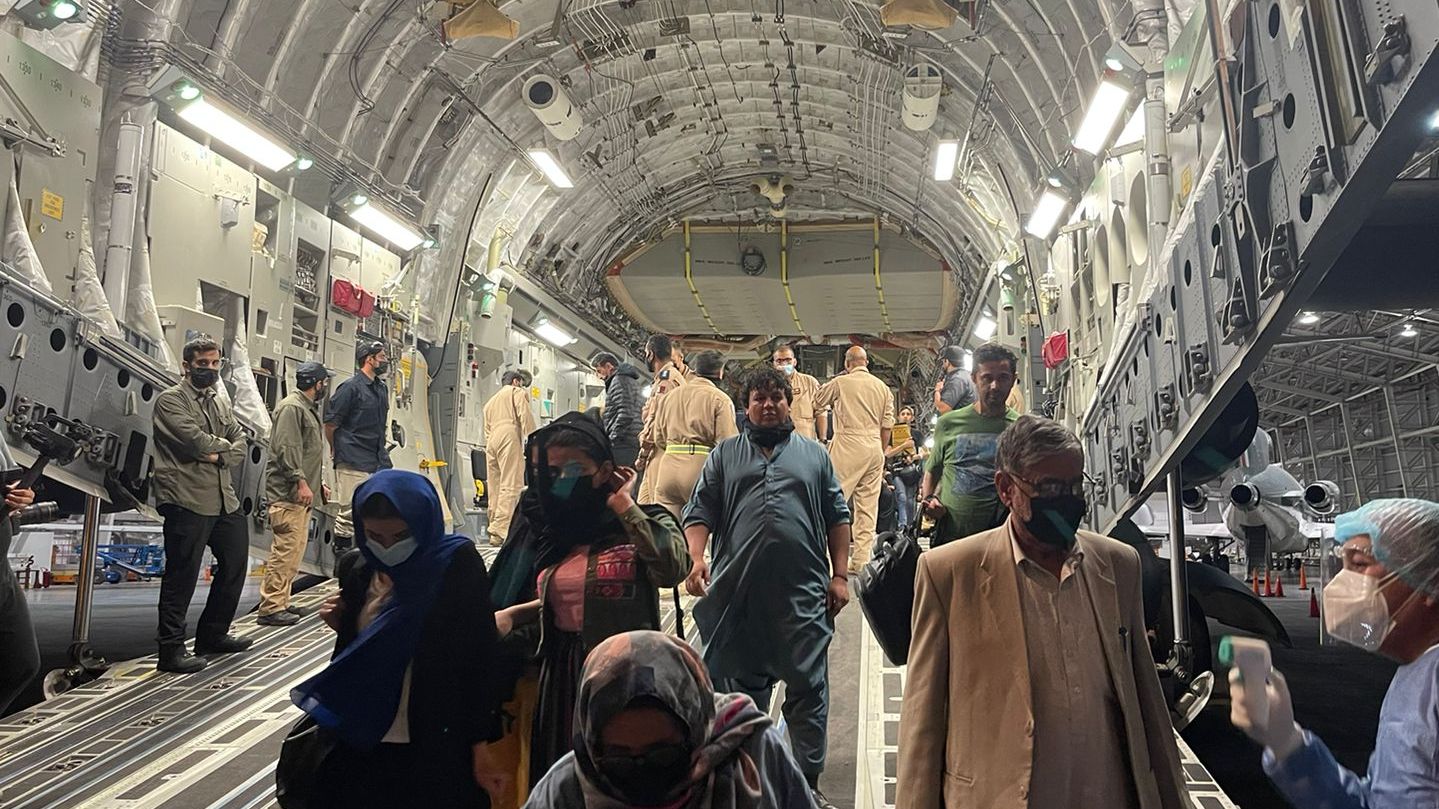
How The New York Times Pulled Off the Historic Evacuation of 124 Afghans Rewrite the following news story as a viral, SEO-optimized article using HTML headings ( , , etc.) for all sections and sub-headings. Only output the article body. — Najim, a well-sourced reporter for The New York Times in Afghanistan, and the brother of Marwa and Mursal, ambitious young women pursuing medicine and law, called from the Kabul bureau in a panic as the family ate their midday meal. “We need to leave. Everything is over here even though we don’t know where we will go,” he told them. Najim had been pushing the Times’ new Kabul bureau chief, Thomas Gibbons-Neff (known as “T. M.”), to get the family on a list being hurriedly assembled of those given top priority to evacuate. As the Taliban advanced with alarming speed, T. M., who had served two tours of duty in Afghanistan as a US Marine, scrambled with others across the Times to find a way to evacuate the Afghans who worked in the bureau. Tension and fear rose as the Taliban closed in. Everyone realized the danger. “Just get one small bag, and pack only a few necessary things and your important documents, not something else,” Najim told his family. “Take no more than thirty minutes and head to the airport,” he warned. The family of nine bolted from their lunch, scattering rice, okra, and bits of dried apricots across the floor as they hurriedly rolled up the oilcloth they were eating on. They left a sink full of dirty dishes. “For my entire life, one backpack,” Marwa said. In an act of defiance, she pulled on the pink and white dress she had meant to wear back to medical school classes that day. When she stepped out on the street for the last time, into the airport-bound flood of humanity, Marwa looked up and said to no one in particular, “Who is staying back to fight for our country?” Kabul Came Knocking, AUGUST 2021, Rebecca For me, Kabul came knocking all at once, almost out of the blue. And quickly, it became all-consuming. I had never been to Afghanistan, but I had long helped manage the scrappy and brave foreign correspondents who chose to go to war zones, both at The Wall Street Journal and The New York Times. I moved to the Times in 2017 as a deputy managing editor. In early 2021, I was asked by publisher A. G. Sulzberger to work as his partner. By early summer 2021, the situation in Afghanistan was careening toward a crisis. Our deputy general counsel, David McCraw, grew increasingly concerned and launched an effort to obtain visas for our local Afghan reporters and staff who were considered to be most at risk. On August 11, one of our leading Afghan journalists, Fahim Abed, sent a note to top editors saying the Times needed to do more to protect the staff who had long worked for us in Kabul. “If you have had a bureau in Afghanistan for twenty years, you know the Taliban,” Fahim recalled writing. “It seems like you don’t have a plan.” Fahim’s note, along with the Taliban’s shockingly rapid advance, spurred us into overdrive to rescue the whole group. A. G. defined the ask: to find a country that would accept a group of the Afghans who had worked in our Kabul bureau and their families and to get them there. It was a tall order. David became our “general.” Revered in journalism and legal circles, David is witty and caring but also a pit bull, a not- so secret weapon for the Times. He is brilliant at suing for access to information, shutting down legal threats with withering letters to opposing counsel, and getting journalists out of harm’s way. Afghanistan was quickly becoming one of the biggest crises that even David had ever faced. With time running out, we pressed every connection we had. A guiding principle that governed the Times’ approach was to treat everyone who worked for the Times as equally as possible— whether they were our Afghan reporters, cooks, or drivers. Our belief was that any Afghan affiliated with a leading US news organization that had reported aggressively about the Taliban had good reason to fear serious retaliation. A. G. wanted to avoid a repeat of a dark episode from the past. His view was shaped by the experience of Times reporter Sydney Schanberg, who had won a Pulitzer Prize in 1976 for his coverage of the fall of Cambodia. A defining moment of that conflict occurred when American journalists fled Phnom Penh in the wake of the sudden, violent takeover by the Khmer Rouge in April 1975. Their local staff were left behind, and many perished in a bloodbath that killed an estimated two million people. Schanberg was one of the few to stay behind with his Cambodian assistant, Dith Pran, but he too was forced to flee the violence two weeks later. Schanberg later wrote about it in a book that became the basis for the acclaimed movie The Killing Fields. Dith miraculously survived and came to America and was long employed as a photographer by the Times. Still, the guilt remained. “I watched many Cambodian friends being herded out of Phnom Penh. Most of them I never saw again. All of us felt like betrayers, like people who were protected and didn’t do enough to save our friends. We felt shame. We still do,” Schanberg wrote in a 1975 article for the Times. More than forty-five years later, A. G. vowed, “I was determined that this wasn’t going to happen again.” On the ground in Kabul, time was running out. The list of evacuees grew ever larger. It fell to Lauren Katzenberg, an indefatigable editor on the international desk, working closely with T. M., David, and Fahim, to collect names, photos, and passports of our group. “I worked probably twenty hours a day. I would cry. Take a Xanax. Sleep for four hours and start again,” said Lauren. A Cross- Country Road Trip, AUGUST 13, 2021, Rebecca As we made calls, I was also caught up in more pedestrian concerns half a world away. On Friday, August 13, I was home in Maplewood, New Jersey, packing for a road trip to a family wedding in Columbus, Ohio. From there, I was to drive my son Eli to Boulder, Colorado, to move him back to college. From the moment we left, the situation in Afghanistan overshadowed everything. While my husband drove, I was glued to my phone, trying to find a country that would take our people. We finally caught a break when our Mexico bureau chief, Azam Ahmed, convinced Mexico, through its foreign minister, Marcelo Ebrard, to take our group in. It was an incredible feat. But we needed to get our group out of Kabul first. I knew instinctively that Qatar was a promising option, as it was the only country that had been hosting talks with the Taliban. Suddenly, I thought of a former colleague from China: Matt Pottinger, a former Wall Street Journal reporter who had deep experience in Afghanistan. His career had taken an unorthodox turn after he became convinced that China’s rise posed a threat to democracy: he trained in secret for more than a year to get an age waiver to join the US Marines at age thirty-two. I had briefly been Matt’s bureau chief in China and we stayed in touch through his two tours of duty in Afghanistan. After returning from Afghanistan, Matt became the deputy director of the National Security Council during President Donald Trump’s first term. He resigned from the Trump administration following the attack on the US Capitol. Before collapsing into bed in Columbus, I emailed Matt, asking if he knew anyone who could help get our group out of Afghanistan. I was stunned to wake up Saturday morning to an encouraging reply. Matt wrote that Qatar could help. Matt gave me an email address to send a formal request. “The situation is dire and many of the staff who have been on the front lines of our Kabul bureau for years and their families are in grave danger,” I typed in a letter that A. G. and I crafted to Minister Al- Khater. Kabul could fall in a matter of hours, and by sending an aircraft, Qatar “could provide a tremendous humanitarian gesture to the Times— and the world,” I wrote. I pressed send just in time to join the wedding. Amazingly, Minister Al- Khater wrote back quickly, pledging to get our people on the first plane Qatar could land. As August 15 dawned in Afghanistan, the Taliban had reached Kabul’s outskirts. A Narrow Opening, AUGUST 15,2021, Rebecca Fahim, the reporter who had sounded the alarm with his letter, noticed that the world had changed before even arriving at work on the 15th. The Afghan soldiers typically stationed at the three checkpoints he passed to get to the bureau were all missing. When he got to the Times compound, the staff were breaking laptops and shredding documents. Amid the mounting chaos, we got a lucky break. Mujib Mashal, a venerated reporter for the Times from Afghanistan who had recently moved to a new post in Delhi, happened to be in Kabul. Mujib was pressed into duty. His first task was to help T. M. get people to the airport. Mujib made calls from the porch of his parents’ home. “I was telling people, ‘Forget about your life. Just run to the airport.’” Fahim spent his final hours collecting all the diaries he had kept since the fifth grade and through building his career and family. He feared they would be too suspicious if they were found. So he poured diesel on them and set them on fire. It took hours for our entire group to reach the airport. Already, the Taliban had seized much of the area. Our people gathered in a small parking lot outside the civilian side of the airport as we pushed to get them to the side still controlled by the US military. Many of our people were meeting for the first time, because they had worked for the Times at different points over the past twenty years or because of strict hierarchies in their roles. I had never met any of them. By nightfall, most people had made it to the airport. Thus began an interminable wait. The initial plan was for them to board a charter flight to Ukraine. Fahim led an effort to get forty people in the group on the plane, but it was far from the terminal. There were no gates and no semblance of order. They arranged to pay a van driver $500 to take them there, but they could fit only half the group in the van. “I saw the nervousness in the face of all the drivers,” Fahim said. “‘If the reporters got out, no one will care about us.’” He decided that it wasn’t right to divide the group. They fled from the van into the dark night, watching as the plane took off without them. “We tried to make sure that if we were in, everyone should be in,” said Fahim in what became a mantra for our group. Thousands of people descended on the airport. During the day, the sun baked, and some of the children fainted in the heat, covered in dust, their cheeks bright red and splotchy. The appeals from the Times reached all the way to an official at the highest level of the US military, who gave approval to get our group to the US- controlled side of the airport. But his promise held no sway on the ground. “I knew we were in trouble when the junior commander on the ground in Kabul said, ‘I don’t care who you spoke to on the phone,’” A. G. said. “Even talking to the chairman of the Joint Chiefs of Staff wasn’t enough.” Around midmorning, our group witnessed one of the most horrific scenes of the fall of Kabul, when people desperate to leave clung to a plane taking off, their bodies falling to the ground. Literally a world away in Columbus, I was rushing to leave the post-wedding brunch to drive to Colorado. Eli’s possessions were in storage there, and I was semi-obsessed with helping him put his bed back together. I couldn’t control a single thing at the Kabul airport, but reassembling college furniture was something I could accomplish. Knowing me well, my husband, Alan Paul, suggested that perhaps he should make the road trip instead given the mounting crisis. But I was determined to show up for a rare mother-son experience. “It will be fine,”I insisted. Of course, it wasn’t fine. Eli drove for hours on end as I worked the phone. After a full day of driving, Eli and I checked into a hotel in St. Louis, and I got on a Zoom call for an update. Then the unthinkable happened. When the Marines moved the vehicles toward our group in an effort to create an opening, our group came under attack. A group of us and Joe were live on a WhatsApp call with Mujib, and we could hear screams as people descended on our group, wielding clubs. We could also hear shots. “Oh my God, they are shooting,” someone said. A number of us broke down in tears, distraught that we could do so little to help our people, thousands of miles away, even as we listened to them being assaulted in real time. Excerpted from the book The Last Free Women: A Daring Escape from Afghanistan and Coming of Age in America by Rebecca Blumenstein and Diana Kapp. Copyright © 2026 by Rebecca Blumenstein and Diana Kapp. Reprinted with permission of Grand Central Publishing, a division of Hachette Book Group, Inc. New York, NY. All rights reserved. Source: WorldNewsAPI | Read original